
What is IBM Content Manager OnDemand (CMOD) Migration?
IBM Content Manager OnDemand (CMOD) migration is the process of extracting, transforming, and transferring archived enterprise documents and metadata from legacy CMOD systems into modern platforms such as cloud-based or enterprise content management (ECM) systems — while preserving full data integrity and accessibility.
IBM Content Manager OnDemand has historically been used for high-volume document archiving, supporting formats such as AFP, PDF, TIFF, and line data, and managing large repositories across industries like banking, insurance, and utilities.
As organizations modernize IT infrastructure and adopt cloud platforms, CMOD migration has become a critical step in digital transformation strategies — enabling reduced costs, improved accessibility, and modern content repositories.
Why Organizations Are Migrating from IBM CMOD
Organizations are actively planning IBM Content Manager OnDemand migration due to several business and technical drivers:
High Maintenance Costs
Aging CMOD infrastructure can carry significant licensing, hardware, and support overhead.
Legacy System Limitations
CMOD was designed for an earlier generation of enterprise computing and may lack modern cloud and API integration.
Cloud Adoption
Organizations moving to cloud-first strategies need content repositories that integrate with modern platforms.
Compliance & Governance
Modern requirements demand improved audit trails, retention controls, and data accessibility.
Scalability Needs
Older CMOD systems may not scale cost-effectively; modern platforms offer more elastic infrastructure options.
AI & Analytics Readiness
Migrating to searchable repositories can enable AI, automation, and advanced analytics on archived content.
Modern platforms offer enhanced capabilities, while CMOD — originally designed decades ago — was built for a different generation of enterprise computing.
DSI’s IBM CMOD Migration Solution
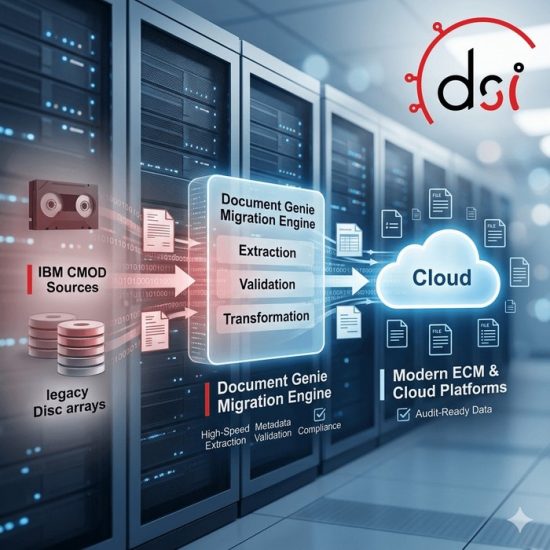
DSI (Data Strategies Interchange) provides IBM CMOD migration services through its Document Genie migration platform — built to handle the complexity of CMOD archive environments.
Key Capabilities
- Extraction of CMOD archives at enterprise scale
- Migration from disk, optical, and tape storage media
- Support for complex legacy formats and metadata structures
- Transformation and normalization of archived content
- Delivery into modern ECM and cloud platforms
- Document reconciliation, metadata verification, and audit reporting
CMOD Migration Without Legacy System Dependency
One of the significant challenges in CMOD migration is dependency on the original system. When the source CMOD environment is unstable, decommissioned, or running on outdated hardware, traditional migration approaches may not be feasible.
DSI’s approach enables:
- Direct extraction from storage systems — disk, tape, and optical media
- Reduced reliance on the original CMOD application layer
- Lower risk when working with unstable or decommissioned environments
This approach is especially relevant for organizations where the CMOD system is no longer under active vendor support, running on aging hardware, or difficult to scale or maintain.
Supported Data Types and Formats
IBM CMOD environments typically contain a wide range of enterprise data. DSI supports migration of common CMOD data types including:
| Format | Full Name | Common Use Case |
|---|---|---|
| AFP | Advanced Function Presentation | High-volume mainframe print streams — statements, reports |
| Portable Document Format | General business documents and correspondence | |
| TIFF | Tagged Image File Format | Scanned documents and images |
| Line Data | Report Archive / Line Data | Legacy mainframe report output and data archives |
| Metadata | Index & Metadata Structures | Document indexing, retrieval keys, and classification data |
All content is transformed into formats suitable for modern, searchable repositories.
DSI’s CMOD Migration Methodology
A successful IBM CMOD migration requires a structured and validated approach. DSI follows a five-step process designed for accuracy, scalability, and minimal operational disruption.
Pre-Migration Analysis
Assess CMOD data structures, volumes, and storage layers. Identify indexing logic and metadata dependencies. Define business and compliance requirements for the target platform.
Data Extraction
Extract documents and metadata directly from storage. Perform offline extraction to avoid impact on production systems and maintain continuity of operations.
Data Transformation
Convert legacy formats into modern, accessible standards. Normalize metadata structures for improved usability and searchability in the target system.
Validation and Reconciliation
Verify document counts and completeness against source records. Confirm metadata accuracy and integrity through audit processes.
Delivery and Ingestion
Prepare migrated data for loading into the target ECM or cloud platform. Enable full integration and verify retrieval capabilities before go-live.
This methodology is designed to ensure accuracy, scalability, and minimal operational disruption.
Key Considerations for IBM CMOD Migration
1. Evaluate System Stability
Many CMOD systems have been running for 15 or more years, often with custom scripts, legacy indexing routines, and aging storage infrastructure. Before migration, organizations should:
- Review system logs and historical errors
- Validate accessibility of archived volumes
- Confirm system performance under extraction load
2. Optimize Extraction Performance
CMOD systems must handle higher I/O load during migration. Key considerations include parallel extraction capabilities, storage throughput limitations, and index performance under stress. Balancing extraction speed with system stability helps ensure a reliable migration.
3. Modernize Content During Migration
A CMOD migration project can be an opportunity to improve long-term content usability. Organizations may consider:
- Converting documents to PDF for broader accessibility
- Applying OCR for full-text search capabilities
- Standardizing metadata schemas and retention policies
These improvements can transform legacy CMOD archives into modern, searchable content repositories.
Where Does CMOD Data Go After Migration?
Organizations typically migrate IBM CMOD data to modern platforms, which may include:
- Cloud-based storage platforms such as those offered by major cloud providers
- Enterprise content management (ECM) systems from vendors such as OpenText, Microsoft, and others
- Modern document repositories with full-text search, compliance, and retention management capabilities
These platforms can provide improved accessibility, better integration with enterprise tools, scalability, and reduced infrastructure costs compared to legacy CMOD environments.
Benefits of IBM Content Manager OnDemand Migration
Migrating from CMOD can deliver meaningful business value:
Reduced Infrastructure Costs
Eliminate legacy hardware, licensing, and maintenance overhead associated with aging CMOD environments.
Improved Data Accessibility
Modern search and retrieval can significantly reduce time to access archived content across the organization.
Enhanced Compliance
Meet modern governance and regulatory retention requirements with purpose-built compliance tools.
Faster Document Retrieval
Full-text search replaces slow, index-based lookups common in legacy CMOD systems.
AI & Analytics Readiness
Migrated content can be made available for AI processing, business analytics, and automation workflows.
Scalable Architecture
Cloud-based target platforms can scale to meet growing content volumes more cost-effectively than legacy systems.
Frequently Asked Questions (FAQ)
Common questions organizations ask when evaluating an IBM CMOD migration project:
What is IBM CMOD migration?
Can CMOD data be extracted without the original system?
What formats are supported in CMOD migration?
How long does CMOD migration take?
How is data integrity ensured during migration?
What systems can CMOD data be migrated to?
Why are organizations migrating away from IBM CMOD?
Conclusion: Modernizing IBM CMOD with DSI
IBM Content Manager OnDemand has served as a reliable archival platform for many organizations, handling large document volumes and demanding enterprise workloads across banking, insurance, utilities, and other industries.
As organizations shift toward cloud-first environments, migrating from CMOD has become a strategic priority for many IT teams. Aging infrastructure, maintenance costs, and integration limitations are driving the move to modern platforms.
With its Document Genie platform and structured migration methodology, DSI (www.go-dsi.com) provides IBM CMOD migration services designed to help organizations modernize their legacy archives and prepare for the next generation of content management.
Related ECM Migration Services & Case Studies
DSI has delivered ECM migration projects across banking, insurance, and utilities sectors worldwide. If you are migrating from a different legacy platform, or would like to review completed CMOD migration projects, the following resources may be helpful.
Other ECM Migration Services
Completed IBM CMOD Migration Projects
Ready to Migrate from IBM CMOD?
Contact DSI to discuss your IBM Content Manager OnDemand migration requirements. Our team will assess your environment and provide a tailored migration plan.
Trademark Notice: IBM and IBM Content Manager OnDemand (CMOD) are trademarks or registered trademarks of International Business Machines Corporation. OpenText is a trademark of Open Text Corporation. Microsoft SharePoint is a trademark of Microsoft Corporation. Amazon Web Services (AWS) is a trademark of Amazon.com, Inc. Google Cloud is a trademark of Google LLC. Microsoft Azure is a trademark of Microsoft Corporation. All other product and company names mentioned are the property of their respective owners. Data Strategies Interchange (DSI) is an independent service provider and is not affiliated with, endorsed by, or sponsored by IBM or any other company referenced on this page. Product names are used solely for the purpose of identifying the systems that DSI’s migration services are designed to support.