Data Strategies Interchange (DSI) provides specialist OpenText Alchemy migration services — extracting documents, overlays, and metadata from legacy Alchemy environments and delivering them into any modern ECM platform with complete fidelity and zero business disruption. Whether you are planning a full archive migration, a phased transition, or a Proof of Concept, DSI has the tools, methodology, and track record to get it done.
Organizations running OpenText Alchemy are increasingly facing pressure to modernize. Aging architecture, rising infrastructure costs, and the demands of cloud-first compliance frameworks are making OpenText Alchemy data migration a strategic priority — and the complexity of Alchemy’s overlay model, proprietary formats, and metadata structure means the choice of migration partner matters.
Why Organizations Migrate from OpenText Alchemy
The OpenText Alchemy platform has served enterprises well for decades, but changing business realities make continued operation increasingly costly and risky. Common OpenText Alchemy migration drivers include:
Limited scalability and reduced vendor investment in legacy OpenText Alchemy environments.
Modern ECM and cloud platforms require migration out of OpenText Alchemy’s proprietary format.
Licensing, infrastructure, and support costs often outpace the value of legacy operation.
Regulatory frameworks require accessible, auditable records on modern platforms.
Difficulty connecting Alchemy to modern business applications and workflows.
Mergers and IT consolidation projects require migrating into a unified content platform.
What Is OpenText Alchemy Data Migration?
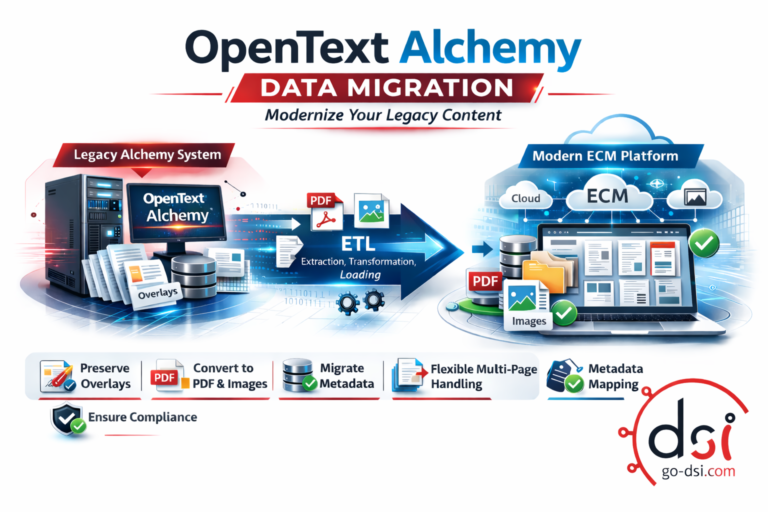
OpenText Alchemy data migration is the structured process of extracting documents, images, and associated metadata from an OpenText Alchemy content management repository and transferring them into a modern Enterprise Content Management (ECM) or archival platform — with full document integrity, overlay fidelity, and metadata accuracy preserved throughout.
A complete Alchemy migration typically involves:
- Extraction of documents from the OpenText Alchemy repository, converted into open formats such as PDF or TIFF
- Correct application of OpenText Alchemy overlays (logos, tables, formatted elements) so documents appear exactly as they do in the original system
- Metadata extraction, validation, and mapping to the target ECM schema
- Flexible multi-page document handling — combined or separated based on target system requirements
- Delivery of content ready for ingestion into any ECM platform, with searchability, compliance, and governance intact
DSI’s Proven OpenText Alchemy Migration Process
Every OpenText Alchemy migration DSI executes follows a proven, structured methodology designed for accuracy, performance, and zero operational disruption.
A comprehensive assessment of the OpenText Alchemy environment is performed — covering document volumes, folder structures, overlay definitions, metadata schemas, multi-page document handling, and any system-specific behaviors that must be preserved during migration.
A detailed migration strategy is defined based on the target ECM’s requirements — covering document formats, grouping decisions, metadata mapping, phasing, and go-live scheduling. Nothing is left to chance.
DSI’s offline extraction methodology pulls documents directly from the OpenText Alchemy repository — without dependency on the Alchemy API. All overlays (logos, tables, headers, formatted text) are fully applied and embedded into each document before conversion, matching the visual output seen in the OpenText Alchemy interface. Documents are delivered in generic, ECM-agnostic PDF or image formats.
Metadata is extracted for every record, validated, and mapped to the target ECM schema — ensuring documents remain searchable, correctly categorized, and fully compliant after migration, using the same index fields as in the original OpenText Alchemy system.
Post-migration validation confirms document counts, metadata accuracy, overlay rendering, and structural integrity. Detailed reconciliation reports are provided, and any exceptions are documented with clear explanations.
Once business users approve the migrated content, the legacy Alchemy system is safely decommissioned — eliminating ongoing licensing, infrastructure, and support costs immediately.
Benefits of Migrating OpenText Alchemy with DSI
Documents appear exactly as they did in OpenText Alchemy — overlays, branding, and layout fully preserved.
Delivered in open, generic formats compatible with any target ECM or archival platform.
Pages combined or separated based on target system functional requirements.
Full searchability retained post-migration using the same index fields as in OpenText Alchemy.
DSI’s offline methodology allows full production use of OpenText Alchemy throughout the migration.
Modern retention, audit, and governance controls replace legacy system limitations.
Immediate reduction in licensing, infrastructure, and operational costs post-decommission.
Decades of experience and multiple successfully completed Alchemy migrations for satisfied global clients.
Supported Target ECM Platforms
DSI can migrate Alchemy content to any modern ECM or document management platform, including:
Proven OpenText Alchemy Migration Results
DSI has successfully completed OpenText Alchemy migration projects for clients across entertainment, financial services, and other industries globally.
- Proof of Concept extraction from an Alchemy environment with hundreds of databases
- Documents included TIFF, JPG, and text files — each with multiple overlays applied
- Text documents superimposed with overlays and converted to PDF format
- Delivered with complete metadata in a structure ready for DocuSign SpringCM ingestion
- DSI’s offline, API-free methodology delivered zero disruption to client operations
- Structured and unstructured documents extracted from an IMR Alchemy archive
- Structured documents prepared with index values for batch-loading into ViewDirect
- Unstructured documents converted to PDF and OCR-processed for full-text search
- Hundreds of thousands of files extracted with complete folder hierarchy preserved
- Executed at DSI’s secure facility using proprietary offline migration tools
OpenText Alchemy Migration — Frequently Asked Questions
- Aging architecture — limited scalability and reduced vendor focus on legacy Alchemy deployments
- Rising costs — infrastructure and licensing costs that outpace the value of continued operation
- Cloud readiness — difficulty integrating Alchemy with modern cloud-native platforms and workflows
- Compliance requirements — regulatory frameworks that are better served by current ECM systems with modern audit and retention controls
- Long-term risk — running unsupported legacy software creates security and operational exposure
- Discovery and environment assessment — document volumes, overlay definitions, metadata schemas, and folder structures are catalogued
- Migration strategy and planning — formats, metadata mapping, phasing, and go-live schedule are defined
- Document extraction with overlay processing — documents are extracted offline and overlays fully embedded before conversion
- Metadata extraction and mapping — all index fields are mapped to the target ECM schema
- Validation and reconciliation — source and target counts are compared and exceptions documented
- Cutover and legacy decommissioning — go-live is executed and the Alchemy system retired
- Archive size and number of databases — larger environments require more extraction and processing time
- Overlay complexity — archives with many overlay types require more rendering work per document
- Document types — TIFF, PDF, Office files, and emails each have different handling requirements
- Multi-page handling — combining or splitting pages adds processing steps
- Execution mode — on-site migration involves additional logistics vs. remote delivery
- Overlay rendering requirements across large document volumes
- Mixed archive formats (TIFF, PDF, Office, emails)
- Multi-page document reassembly requirements
- Phased cutover schedules or parallel running periods
- Overlay handling — Alchemy stores overlays separately from base documents; if not correctly rendered during extraction, documents lose visual fidelity in the target system
- Metadata completeness — index fields must be accurately mapped to the target schema to preserve searchability and compliance; gaps in mapping leave documents effectively unsearchable
- Multi-page document logic — Alchemy structures pages differently from most modern ECMs; reassembly rules must be defined upfront to avoid fragmented records
- Large archive scale — API-based approaches are often too slow for large-scale Alchemy environments and can significantly extend timelines, increasing the risk of incomplete data transfer; offline extraction is strongly recommended
- Text documents with overlays — rendered to PDF with overlays fully embedded
- Image-based documents (TIFF, JPG, BMP) — converted to TIFF or PDF based on target system requirements
- Microsoft Office files — extracted as-is or converted to PDF depending on target platform ingestion requirements
- Emails and attachments — extracted and converted as needed, preserving associated metadata
- Microsoft SharePoint Online
- DocuSign SpringCM
- DocuWare
- Hyland OnBase
- IBM Content Manager
- OpenText Documentum
- Alfresco
- Other OpenText ECM platforms
- Microsoft SharePoint Online — cloud-native, widely adopted across industries
- Hyland OnBase — strong choice for regulated industries such as healthcare and insurance
- DocuWare — mid-market ECM with strong document workflow capabilities
- OpenText Documentum — enterprise-scale ECM for complex content environments
- IBM Content Manager — suited for large-scale enterprise deployments
- DocuSign SpringCM — contract-focused document management
- Alchemy-specific overlay handling — the provider must have tooling that correctly renders and embeds overlays during extraction
- Offline (non-API) extraction methodology — essential for speed and zero disruption to the production system
- Metadata validation and reconciliation reporting — ensures every index field is accounted for and exceptions are documented
- Flexible output formats and multi-page document handling — aligned to target ECM requirements
- References from completed Alchemy migrations at scale — not just general ECM experience
Related ECM Migration Services from DSI
DSI provides migration services for a broad range of legacy ECM and document management platforms worldwide.
Start Your OpenText Alchemy Migration Today
If your organization is planning to migrate from OpenText Alchemy, DSI provides the expertise, tools, and proven methodology to ensure a secure, accurate, and complete transition to any modern ECM platform. Contact us to request a free assessment.
Request a Free Migration Assessment