Organizations that have relied on OpenText Alchemy for document management and archival needs are increasingly facing challenges as digital transformation accelerates. While Alchemy has served as a dependable legacy system, evolving business requirements, compliance mandates, and the need for cloud-ready platforms are driving enterprises to consider OpenText Alchemy data migration as a strategic initiative.
DSI specializes in migrating complex Alchemy environments while preserving document fidelity, metadata accuracy, and business usability.
Why Migrate from OpenText Alchemy?
OpenText Alchemy is often deeply embedded in business operations, storing years—sometimes decades—of critical documents, images, and records. However, organizations commonly face limitations such as:
- Aging architecture and limited scalability
- Difficulty integrating with modern ECM and cloud platforms
- Increasing infrastructure and support costs
- Compliance and governance challenges
- Reduced vendor focus on legacy Alchemy deployments
A structured migration enables organizations to retain valuable information while transitioning to a modern, future-ready content platform.
What Is OpenText Alchemy Data Migration?
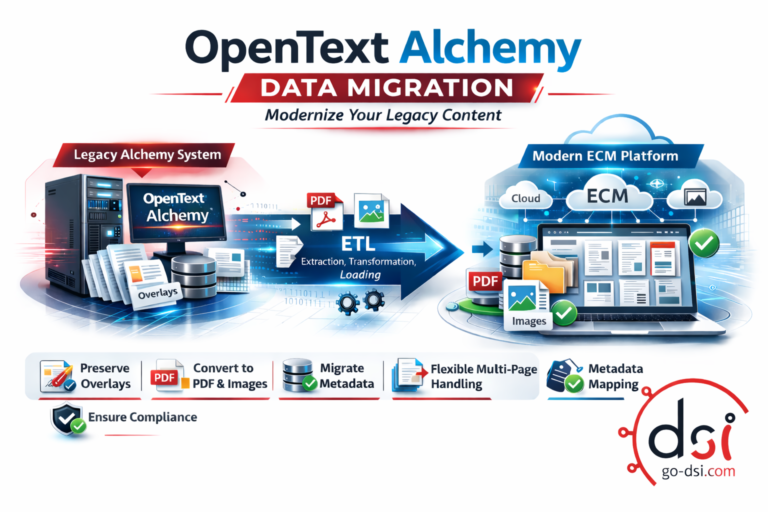
OpenText Alchemy data migration is the structured process of extracting, transforming, and loading (ETL) documents, metadata, and content relationships from Alchemy into a New target system.
DSI’s migration approach ensures that documents appear exactly as they did in the Alchemy GUI, while being converted into open, generic formats that can be loaded into virtually any ECM solution.
Key Components of an Alchemy Migration Project:
1. Discovery and Assessment
The Migration process begins with a comprehensive assessment of the Alchemy environment, including document volumes, folder structures, overlays, metadata definitions, and multi-page document handling. This phase identifies system-specific behaviors that must be preserved during migration.
2. Migration Strategy and Planning
A detailed migration strategy is defined based on the target ECM’s requirements. This includes decisions on document formats, document grouping, metadata mapping, and whether migration will be executed in phases or as a single cutover.
3. Document Extraction, Overlay Processing, and Transformation
OpenText Alchemy frequently uses overlays to apply tables, logos, and formatted content on documents. During migration:
- DSI ensures that all overlays are correctly applied to each document, matching the visual representation seen in the Alchemy GUI
- Documents are converted into PDF or image formats, preserving layout, branding, and readability
- Extracted documents are delivered in generic, ECM-agnostic formats, enabling seamless loading into any target ECM platform
For folders containing multi-pages/ page separated documents, DSI supports flexible handling:
- Pages can be combined into a single document, or migrated as separate pages or records, depending on the target ECM’s functional and business requirements
4. Metadata Extraction and Mapping
Metadata is a critical component of Alchemy migrations. DSI extracts metadata for each record, validates it, and maps it to the target ECM schema. This ensures that documents remain searchable, categorized, and compliant after migration.
5. Validation and Reconciliation
Post-migration validation confirms document counts, metadata accuracy, overlay rendering, and structural integrity. Reconciliation reports provide assurance that all records have been successfully migrated and if any exceptions, reasons for the same will be reported.
6. Cutover and Legacy System Decommissioning
Once business users approve the migrated content, the Alchemy system can be safely decommissioned—reducing licensing, infrastructure, and operational costs.
Benefits of Migrating OpenText Alchemy with DSI
- Exact visual fidelity – Documents appear exactly as they did in Alchemy
- Overlay preservation – Tables, logos, and formatting retained
- ECM-independent output – Generic formats compatible with any ECM
- Flexible multi-page handling – Aligned to target system needs
- Improved compliance and governance – Modern retention and audit controls
- Lower total cost of ownership – Retirement of legacy infrastructure
- Metadata Preservation – Documents will be searchable using same Metadata as in Alchemy
- Experienced & Successful – Decades of Experience and track record of completing multiple successful projects with Satisfied customers
Conclusion
OpenText Alchemy data migration is more than a technical exercise—it is a critical step in enterprise content modernization. With DSI’s proven migration approach, organizations can confidently transition from Alchemy while preserving document integrity, metadata accuracy, and business usability.
By converting legacy Alchemy content into open, future-ready formats, enterprises position themselves for improved compliance, scalability, and long-term digital transformation.
Visit this page to learn about our recent project completions here.
FAQs
OpenText Alchemy data migration is the structured process of extracting documents, images, and associated metadata from the OpenText Alchemy content management system and moving them to a modern Enterprise Content Management (ECM) or archival platform, while preserving document integrity, metadata accuracy, and business usability.
In a typical Alchemy migration:
Documents are extracted from the Alchemy repository and converted into open, generic formats such as PDF or images
Alchemy overlays (logos, tables, and formatted elements) are correctly applied so documents appear exactly as they do in the Alchemy user interface
Metadata for each record is extracted, validated, and mapped to the target ECM system
Multi-page documents can be migrated as a single combined document or as separate pages, depending on the target system’s requirements
The migrated content is loaded into the target ECM with searchability, compliance, and governance intact
DSI Preserves OpenText Alchemy overlays by ensuring that every document is rendered exactly as it appears in the Alchemy user interface before migration.
OpenText Alchemy often uses overlays to apply elements such as logos, tables, headers, footers, and formatted text on top of base documents. During migration, DSI’s process:
Applies all Alchemy overlays to each document during extraction
Renders the document with overlays fully embedded, matching the visual output seen in the Alchemy GUI
Converts the rendered documents into PDF or image formats, preserving layout, branding, and readability
Ensures the output is in generic, ECM-independent formats that can be loaded into any target ECM or archival system
By embedding overlays directly into the migrated documents, DSI eliminates dependency on Alchemy-specific rendering logic and guarantees that documents remain visually consistent, compliant, and usable after migration.
Multi-page documents can be migrated as a single combined document or as separate pages, depending on the target system’s requirements
Data From Alchemy can be migrated to Opentext ECMs, Docusign, Microsoft SharePoint Online, DocuWare, OnBase, Documentum and IBM CMOpag